


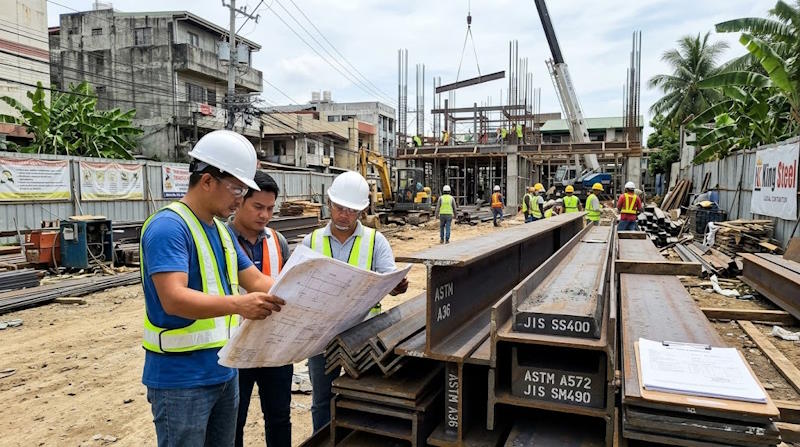
When managing construction sites or handling procurement in the Philippines, it can be an arduous task to figure out which steel grade will be required. When presented with the latest structural blueprint drawn up by a structural engineer, most likely specifying structural steel grades Philippines such as ASTM A36, I have sent my purchase order to some of the top local steel yards in Metro Manila or Cebu only to receive an inventory list containing materials such as JIS SS400 or ASTM A572 Grade 50.
The confusion between these different structural steel grades can lead to more than just a costly procurement nightmare. It has led to delivery rejections at the construction site’s gates, delays in pouring concrete slabs, structural re-engineering fees, budget overruns because of over-specified materials, and much more!
This cheat sheet provides all the info you need to know about various types of steel, including both American (ASME & ASTM) and Japanese (JIS).
Understanding the Standard Organizations: Who Codes What?
Here are some details that help put things into perspective before you start looking at individual grade comparisons.
Who Writes These Grades? Why Are They There?
ASTM (American Society for Testing and Materials)
ASTM standardizes the material composition as well as physical performance (i.e., yield strength, tensile limits, etc.) of the steel.
When your engineering team specs out a specific grade like ASTM A36 or A500, they’re concerned with things like chemical balance and testing procedures. In short, ASTM will tell you what the hell your steel is made of and just how strong it is.
ASME (American Society of Mechanical Engineers)
The American Society of Mechanical Engineers (ASME) also has specific approvals on ASTM specs to be used with pressure applications.
If you’re using a material that’s going to withstand high levels of pressure or heat (or even volatile substances like those found in boiler tanks, pressure vessels, and industrial processing lines), then it falls under ASME’s governance. Typically, they simply prepend your ASTM code with an “S.” So if you’re dealing with ASTM A53 pipe, look for ASME SA53 if it’s been cleared for use in pressure systems.
JIS (Japanese Industrial Standards)
These JIS standards originate from Japan and are dominant for procurement across Southeast Asia, where they’re widely used by Japanese mills and local traders.
Codes such as SS400 (for Structural Steel 400MPa Tensile), or SM490 (for Structural Marine/Welded Steel), relate only to the minimum Ultimate Tensile Strength of the material – not its Yield Strength.
ASME vs ASTM vs JIS: Quick Comparison Table
Here is how common structural steel grades line up when handling Philippine steel procurement:
|
Standard |
Typical Grade Code |
Key Focus |
Common Local Uses in PH |
Equivalent / Close Match |
|
ASTM |
ASTM A36 |
Min yield strength (~250 MPa / 36 ksi) |
Base plates, I-beams, channel bars, framing |
JIS G3101 SS400 |
|
ASTM |
ASTM A572 Gr 50 |
High-strength low-alloy (~345 MPa yield) |
High-rise columns, bridges, heavy trusses |
JIS G3106 SM490 / SS490 |
|
ASTM |
ASTM A500 Gr B/C |
Structural tubing (HSS – square/rectangular) |
Structural columns, trusses, posts |
JIS G3466 STKR400 / STKR490 |
|
ASME |
ASME SA516 Gr 70 |
Pressure vessel plate (boiler quality) |
Storage tanks, industrial boilers |
JIS G3115 SPV355 |
|
JIS |
JIS G3101 SS400 |
Min tensile strength (400-510 MPa) |
Wide flange beams, angle bars, steel plates |
ASTM A36 |
|
JIS |
JIS G3106 SM490 |
Welded structural steel |
Heavy structural framing, crane girders |
ASTM A572 Grade 50 |
Why Filipino Procurement Heads Suffer Budget Overruns
Over-specifying steel is one of the quickest ways you can bust your project’s budget.
-
Hard-to-Find Specs Cause Import Delays
Perhaps you’re using a blueprinted design that calls out an ASTM grade simply because the design software defaulted to US standards.
If your local distributor only has JIS equivalent plates stocked, then placing a special order for the exact US mill cert could mean paying top dollar for air freights or sitting around for 60-90 days while they pull a sea freight container of this material in from overseas.
-
Confusing Yield Strength with Tensile Strength
The ASTM designates its minimum yield stress as A36 (that’s 36ksi/roughly 250MPa). In contrast, the JIS notes that its minimum tensile stress is SS400 (this is 400MPa, with the corresponding yield stress being ~235-245MPa, dependent on plate thickness).
The two grades are effectively the same when it comes to general building construction. But don’t be fooled by this similarity—swapping one out for another without considering their thickness limitations may prevent you from getting your structural signs off.
-
Paying Pressure-Grade Prices for Structural Work
If you buy ASME SA36 rather than ASTM A36 or JIS SS400 you are paying extra money on boiler grade testing certifications that you don’t actually need if building a normal commercial warehouse frame.
Practical Site Sourcing Tips for Philippine Construction
To streamline procurement without compromising site safety:
Request equivalent approval early: Submit mill test certificates (MTC’s) to your structural engineer of record before you place your purchase order that show how jis ss400 meets astm a36 design load requirements. Check plate thickness factors: the yield strengths for jis ss400 drop off slightly when plate thicknesses are more than 16mm/40mm. make sure your site team double-checks with their structural thickness tables. Verify mill test reports (mtRs). don’t be fooled by what’s stamped on the steel bundle. demand real heat numbers and mtRs from your supplier to ensure that the yield, tensile, and chemical properties actually match up with site specs
Key Takeaways
ASTM regulates general structural steel quality & composition within North America’s standards. ASME regulates pressure vessels & boilers with additional safety testing on pressurized environments. JIS is an East Asian standard commonly stocked at local regional mills & Philippine suppliers.
While ASTM A36 and JIS SS400 can be used interchangeably for most building applications, you should check if there are specific thickness limitations that need to be met by consulting with an engineer first.
Our smart cross-referencing will keep you from running into unexpected order delays due to material compatibility issues as well as avoid over-running budgets through projects.
Streamline Your Steel Sourcing Today
Avoid costly delays due to specification mismatch issues by partnering up with a trusted supplier who knows your site’s local realities as well as international steel standards.
Visit the King Steel Contact Us page now for details on how we can ensure you’re always supplied with quality steel products backed by certified mill test reports at speed of deliveries to sites throughout the Philippines. Call our steel procurement specialists today!

Leave a Reply