


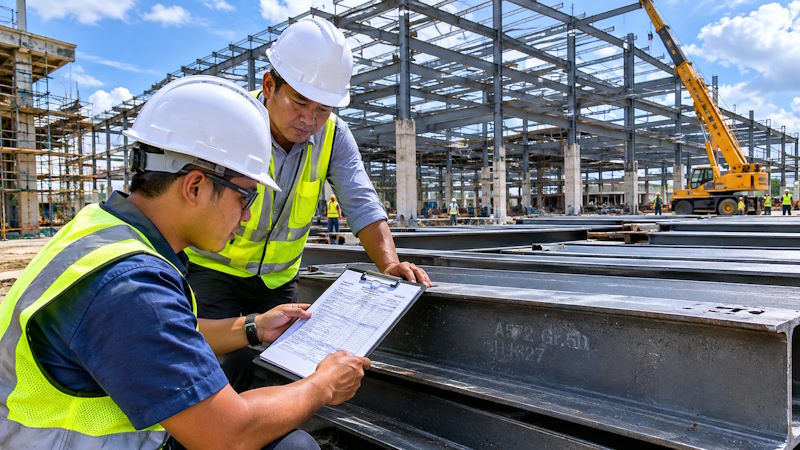
Picture this. Your new warehouse is 80 percent built. The frame is up, the roof sheets are on order, and your lender is expecting the next progress report. Then the building official walks the site, asks for mill test certificates, and the paperwork doesn’t match the steel sitting in front of him.
Work stops. Nobody argues about it for long, because there isn’t much to argue.
This happens more often than owners like to admit. Steel looks the same from ten meters away. A beam rated for one standard can sit next to a beam rated for another, and unless someone checks the stamp, the heat number, and the paperwork, you won’t know which is which. The trouble starts later, usually at the worst possible time.
This article explains how steel standards work in the Philippines, where projects go wrong, and what you can do before a single bolt is ordered.
What “Steel Standard” Actually Means
A steel standard is a written rulebook. It spells out what a grade of steel must contain, how strong it must be, how it should be tested, and how it should be marked. When your structural engineer writes “ASTM A36” or “ASTM A572 Grade 50” on a drawing, that isn’t a suggestion. It is a legal and engineering instruction.
Three families of standards show up on most Philippine projects.
ASTM comes from ASTM International in the United States. The ASTM steel specification you’ll see most often includes A36 for general structural plates and shapes, A572 Grade 50 for higher-strength members, A500 for hollow sections, A615 for reinforcing bars, and A106 for pipe.
ASME is the American Society of Mechanical Engineers. Its codes matter most when steel is under pressure or heat. Boilers, pressure vessels, and process piping fall here. The ASME Boiler and Pressure Vessel Code and the B31 piping codes decide which materials can be used and how welds must be made and tested.
JIS is the Japanese Industrial Standard. Many Philippine plants run Japanese equipment, and many suppliers bring in Japanese-grade steel such as SS400 (JIS G3101) for structural work or SD295 and SD390 (JIS G3112) for rebar.
None of these is “better” than the others. The problem comes from mixing them without checking, or swapping one for another because the price looked good.
How the Philippine Rules Fit Together
The legal backbone for construction here is the National Building Code (Presidential Decree 1096) and its implementing rules. Structural design follows the National Structural Code of the Philippines (NSCP), which points to recognized material standards, many of them ASTM. The Department of Trade and Industry, through the Bureau of Philippine Standards, also requires mandatory product certification for certain steel products, including deformed steel bars. For plants with boilers or pressure equipment, the Philippine Mechanical Engineering Code and Department of Labor requirements add another layer.
In plain terms: the drawings name a standard, the code backs it up, and the building official can ask you to prove the steel on site matches it. If you can’t, you have a problem.
A fair warning: rules get updated, and local offices read them in their own ways. Always confirm current requirements with your structural engineer and your local building official before you finalize a bill of materials.
The Legal Risk: Permits, Stop Orders, and Liability
Let’s start with the one that wakes owners up at night.
A building official has the authority to withhold or suspend permits when materials don’t match approved plans. That can mean a stop-work order in the middle of construction, or a refusal to issue the Certificate of Occupancy when you’re ready to open. Either one freezes your revenue. A shopping center that can’t open still pays its loans.
Then there’s liability. If a structure fails and the investigation finds that the steel didn’t meet the specified grade, responsibility doesn’t stay with the supplier. It can travel up to the contractor, the engineer who signed off, and the owner. The National Building Code carries penalties, and civil and criminal cases can follow serious failures. After an injury or death, “we trusted the supplier” won’t carry much weight.
Insurers notice too. A claim tied to non-compliant materials can be disputed, delayed, or reduced.
The Structural Risk: When Steel Doesn’t Behave the Way the Design Assumed
Engineers don’t pick a grade at random. The numbers in the design, like yield strength, ductility, and weldability, come straight from the material standard.
Take a simple example. A designer calculates a column using steel with a minimum yield strength of 345 MPa (that’s ASTM A572 Grade 50). The contractor swaps in a cheaper grade rated at 250 MPa because it looked “close enough.” The column now carries less load than the drawings say it can. On a calm day, nothing happens. In a strong typhoon, or under a heavy crane load, the margin that was supposed to protect people is gone.
The Philippines adds its own pressure. We sit on the Pacific Ring of Fire, and we get an average of around twenty tropical cyclones entering the area of responsibility each year. Structural steel has to handle earthquakes and wind, and ductility matters just as much as raw strength. Steel that cracks instead of bending is dangerous in a quake.
Welding is another weak point. Different grades need different filler metals and different heat control. Weld the wrong grade with the wrong procedure and you can create brittle joints that look perfectly fine until they’re loaded.
For anyone who cares about structural steel safety, the lesson is simple: the grade on the drawing and the grade on site must be the same, and you need paper to prove it.
ASME Compliance in Industrial Plants: Where the Stakes Get Higher
If you own or build an industrial plant, ASME is where small mistakes turn expensive fast.
A pressure vessel or steam line holds a lot of stored energy. If it fails, it doesn’t just crack. It can rupture violently. That’s why ASME compliance construction requires materials with documented chemistry and strength, qualified welders, approved welding procedures, and inspection records at each stage.
Plants that skip these steps often find out during commissioning or insurance inspection. At that point the vessel may need to be derated, re-tested, or removed. In the worst case, a regulator or insurer refuses to let it run until the documentation problem is solved, and sometimes it can’t be solved on paper at all. The steel has to come out.
For a food processing plant, a power facility, or a chemical line, that means weeks or months of lost production.
The Financial Risk: Where the Money Disappears
Owners usually worry about the price per ton. The bigger number sits somewhere else.
Here’s an illustrative example, not a real client case. Suppose a developer saves a few percent on a steel package by accepting an unverified substitute. Six months later, an inspector flags the material. Now the project faces some combination of these costs: testing and re-certification fees, engineering re-checks, removal and replacement of installed steel, crane and labor time to do the work twice, rent or loan interest during the delay, and possible penalty clauses with tenants or customers.
The replacement bill alone can eat the original savings many times over. Add a delayed opening date and the loss gets much bigger.
Steel prices also swing. Replacing a rejected shipment in the middle of a project means buying at whatever the market is doing that month, often with a rush premium on top.
Where Projects Usually Go Wrong
Most non-compliance isn’t fraud. It’s carelessness, rushed buying, or a gap in who checked what. These are the patterns we see most.
A supplier offers “equivalent” steel. Sometimes it really is equivalent. Often nobody has run the comparison between, say, JIS SS400 and ASTM A36 for the specific use. The two overlap, but they aren’t identical, and chemistry and testing rules differ.
Mill test certificates go missing, or they don’t match the heat numbers stamped on the steel. A certificate that can’t be traced to the actual material is just a piece of paper.
Imported steel arrives without the right documentation for local approval. Customs clears it, but the building official won’t.
Design drawings call out one standard while the purchasing team orders another because it’s in stock. Engineering and procurement rarely talk during rush periods.
And sometimes the steel is simply mislabeled or counterfeit. It happens in every market.
How to Protect Your Project Before You Order
You don’t need to become a metallurgist. You need a short, disciplined process.
Start by locking the standard in writing. Every steel item on the bill of materials should name the exact specification and grade, such as ASTM A572 Gr. 50 or JIS G3112 SD390, and nothing vague like “high-strength steel.”
Next, require mill test certificates for every delivery. The heat number on the certificate has to match the marking on the steel. Spot-check it when the truck arrives, before the material goes into the structure. Ask for third-party testing on anything critical.
If a supplier proposes a substitute, send it to your structural engineer in writing and wait for written approval. A verbal “it’s the same thing” doesn’t count.
For pressure systems, confirm that welders and procedures are qualified under ASME rules before work starts. Retrofitting qualification after welding is expensive and sometimes impossible.
Finally, talk to your building official early. Ask what documents they expect at inspection, and gather them as you go instead of scrambling at the end.
Work with a supplier who treats paperwork as part of the product. If a vendor gets annoyed when you ask for certificates, take that as your answer.
Key Takeaways
- Steel standards (ASTM, ASME, JIS) are binding design instructions, and the grade on site must match the grade on your approved drawings.
- Non-compliant steel can bring stop-work orders, a withheld Certificate of Occupancy, disputed insurance claims, and legal exposure for owners, contractors, and engineers.
- A cheaper substitute that has a lower yield strength or poor ductility puts people at risk, especially in a country with strong earthquakes and typhoons.
- ASME-governed equipment such as boilers, pressure vessels, and process piping needs documented materials, qualified welders, and inspection records. Missing paper can mean the equipment can’t run.
- The savings from a questionable steel order are usually small. Replacement, retesting, and delay costs are much larger.
- Put the exact standard in writing, demand traceable mill test certificates, and get written engineer approval for any substitution.
Build on Steel You Can Prove
A shutdown costs far more than a careful purchase order. If you’re planning a plant, warehouse, or commercial building and you want the steel specification right the first time, King Steel PH can help you match materials to your drawings and the standards your project needs.
Contact King Steel PH today and talk to our team about your next project before the order goes out, not after the inspector arrives.

Leave a Reply